When a crane, winch or hoist spools more than one layer of wire rope onto a smooth drum, the rope begins to destroy itself. Cutting-in, crushing, and unpredictable gapping dramatically shorten rope life, create safety hazards, and increase downtime. LeBus groove, the counterbalanced parallel grooving system, has provided a field-proven engineering answer for many years.
The First Killer: Cutting-In
On a smooth drum, the second layer of wire rope does not sit neatly into the valleys of the first layer. Instead, as the rope winds helically, it tends to drift. Voids and gaps open up between coils. When the next layer adds load, the upper rope cuts down into those gaps, crushing and abrading the lower layers. This “cutting-in” phenomenon concentrates stress on small rope sections, leading to premature strand breaks.
According to LeBus technical team, a helical grooved drum often provides one less wrap on the second layer compared to the first. Wraps on subsequent layers alternate or deteriorate, and voids inevitably appear. The result is a rope that fails long before its calculated service life.
The Second Killer: Crushing and Scrubbing
Multi-layer spooling without controlled grooving creates extreme point loads. As the rope crosses itself at steep angles – a full 360° helical crossover on each wrap – the wire strands are subjected to both crushing pressure and abrasive scrubbing. This is especially severe under high line tension.
“Overwinding and crosswinding substantially weakens the wire rope strands due to the crushing and abrasive scrubbing derived from this helical movement.” In many oilfield, marine and mining applications, this damage forces rope changes several times a year, costing operators tens of thousands of dollars in material and lost production.
The Third Killer: Unpredictable Gapping and Layer Instability
When the first layer on a smooth drum is laid under high tension, the rope flattens and strands spread. This creates an uneven foundation. Subsequent layers then pile up randomly, with some coils forced against the drum flanges and others loosely stacked. The result is a chaotic spooling pattern that can cause the rope to jam, jump off the drum, or suddenly slip.
Operators often have to slow down winch speeds or manually re-spool the rope – a dangerous and time-consuming task. However, nothing is more damaging to the cable than such an operation.
The LeBus Solution: Parallel Grooving with Counterbalanced Crossovers
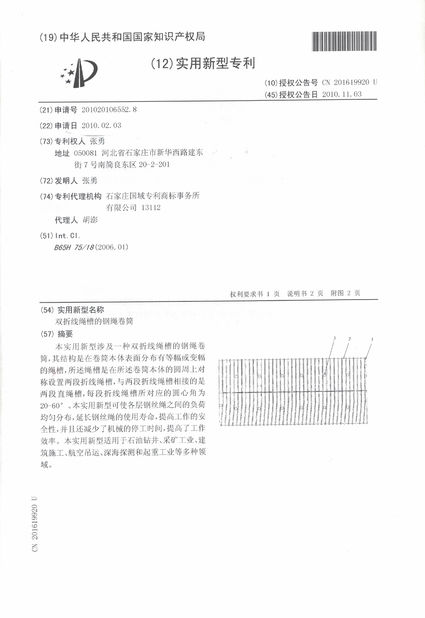
LeBus solved these three problems with a parallel spooling system that has become the industry benchmark. Instead of a continuous helix, the LeBus groove runs parallel to the drum flanges for about 80% of the drum’s circumference. Only two short angled sections – the crossover zones – move the rope across by half a pitch per half revolution. These crossovers are placed opposite each other, balancing the drum dynamically.
Key benefits:
-
No cutting-in: Each layer of rope is fully supported by the layer below. The pyramid pattern (triangular build-up) eliminates voids, so the upper rope cannot cut down.
-
Predictable scrubbing: All rope-to-rope contact damage is confined to the crossover zones – only about 20% of the drum circumference. Engineers can predict fatigue and extend rope life by periodically cutting the rope to shift the crossover zone to fresh sections.
-
Stable layers: The LeBus groove holds the first layer securely, preventing flattening and strand spreading. The parallel sections keep coils neatly side by side, reducing flange pressure and eliminating gapping.
Proven Results Across Industries
LeBus users report dramatic improvements. Oilfield customers say the system pays for itself in drilling a single well. Mining operators have seen wire rope life increase by 55%. Marine and crane operators cite “dependability and performance” as the biggest gains – especially on anchor winches, deck cranes and floating cranes where failure at sea is not an option.
The system is available as split steel sleeves (bolted or welded over existing drums), integrally machined grooved drums, or lightweight fiberglass sleeves for non-magnetic applications. LeBus engineers custom-calculate groove pitch and crossover design based on rope construction, drum diameter, number of layers, and operating tension.
A Note on Tension
LeBus emphasises that adequate rope tension is essential – typically at least 10% of the rope’s safe working load. Without sufficient tension, even the best groove pattern cannot hold the rope in place.
Bottom Line
Multi-layer spooling does not have to destroy wire rope. By converting random cross-winding into controlled parallel spooling with balanced crossovers, LeBus eliminates cutting-in, minimises scrubbing, and provides a stable, predictable foundation for dozens of layers. For any crane or winch that spools more than one layer of rope, the LeBus system is not an expense – it is an investment in safety, rope life, and operational efficiency.
For more information, visit Shijiazhuang Junzhong Machinery Manufacturing Company(www.winchlbs.com) or contact our engineering team for a custom spooling analysis.



 Your message must be between 20-3,000 characters!